
Check for safety before you start
Powerlines and power poles
Check overhead and underground power lines
Electrical Infrastructure
Report any damage to electrical infrastructure
Electrical and other equipment
Ensure all equipment is in working order
Preparation Checklist
If you have any questions or concerns, always call us first on 13 23 51. If necessary, we can disconnect the power supply so you can safely carry out the work you need to do.
- Once you have looked around and located electrical infrastructure, mark them at ground level.
- Be aware that the distance of powerlines from the ground may appear to be higher or lower depending on the angle from which they are viewed.
- If powerlines are located near your work area, always call us first. We’ll let you know about the voltage levels and the safe clearances which need to be maintained before you start. Don’t assume you know where power poles and powerlines are as new infrastructure may have been installed.
- If powerlines are located near your work area, always call us first. We’ll let you know about the voltage levels and the safe clearances which need to be maintained before you start.
- Don’t assume you know where power poles and powerlines are as new infrastructure may have been installed.
Make sure you and your workers are suitably trained to carry out the work required.
If your vehicle comes into contact with power infrastructure, it could be electrified and so could the ground around it.
The safest option is likely to be staying in your vehicle until authorities arrive to make the area safe. Always call us on 13 23 51 - or call 000 in a life-threatening emergency.
Learn more about what to do if your vehicle comes into contact with a fallen powerline
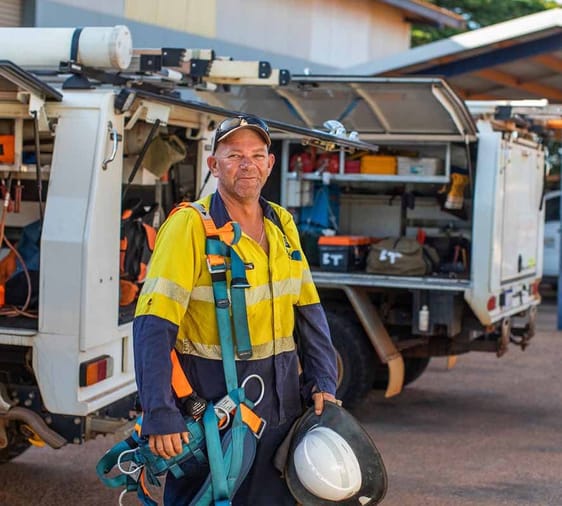
We need access to electrical assets on your property at all times
For safety reasons, we need clear access to all of our electrical assets — like power poles or transformers — at all times.
When we access your property, we always try to limit movement as much as possible and we make sure that gates are left open or closed as they were found.
If for some reason access will be restricted or if there are any access issues, please let us know straight away.
Before you start work on your property
Powerlines, power poles and other electrical infrastructure can all present serious safety risks. Do some basic checks before starting work.
If you see damaged equipment or are in an electrical emergency call us immediately on 13 23 51.
Frequently asked questions
The Energy Operators (Powers) Act 1979 (WA) gives Horizon Power and its employees and contractors the right to lawfully enter and occupy any property in Western Australia for the purpose of construction, extension, maintenance or fault and emergency works relating to its function as an energy operator.
If we need to access that corridor via farm roads, tracks, gates, fence lines, and/or we will need to deal with livestock, where practicable, we will contact you to make arrangements beforehand.
These arrangements will include how the land is to be secured during and after the completion of works.
Managing risks and hazards
If you operate a farming or agriculture business, the Work Health and Safety Act 2020 (WA), s 19 requires you to ensure the health and safety of workers and other persons, including contractors, while on your property. When we conduct work on your property we also must ensure that we maintain safety standards at all times.- Let us know if there are any hazards we need to be aware of before we commence work on your property.
- Make sure you are aware of your legal obligations under the Work Health and Safety Act 2020 (WA) and other relevant legislation.
- Stay up to date with your safety obligations by accessing WorkSafe WA and other WA State Government resources.
Drones
- When we use drones to inspect our electrical assets, we share relevant flight schedule information with affected residents.
- Where practicable, we also share information about planned drone activity on social and print media, radio, and consultations with local businesses.
- Our vehicles and drones are branded with Horizon Power markings.
- We use consistent messaging about drones to make our purpose for using them clear.
Conducting works during total fire bans or Harvest and Vehicle Movement Bans
- We have well-defined processes for conducting works during total fire bans and Harvest and Vehicle Movement Bans, and we have an exemption under the Bush fires Act 1954 (WA).
- We have tight controls in place to mitigate the risk of starting a fire during these times. Our teams are regularly trained and we have key scenarios they may face mapped and prepared for.
- We use non-flame producing tooling.
Pole and asset base clearing
- Vegetation management programs
- Power & Hand tools
- Chemical use (predominately Method 240SL)
Biosecurity
- Our teams complete biosecurity training and understand how to prevent risks when working on farm properties.
- We have clearly defined cross-contamination prevention procedures that are teams follow, including regularly:
- Checking vehicles for the spread of weeds.
- Cleaning vehicles at wash down bays.
- Checking footwear before leaving an affected area.
Risk analysis and control
- We also conduct a job risk analysis process for other potential hazards.
- This process supports the swift identification, control and recording of identified hazards specific to a work location.
Crop dusting can interrupt power supply

If you plan on digging or excavating, it’s important you don’t start until you know where underground cables are located. Because accidentally hitting or damaging underground cables can be costly and dangerous. It could even cost you your life.

Read our quick guide on how to take care around electrical infrastructure you can and can't see.

Electricity connects to your home in different ways, through either overhead or underground power. In both instances, a network service wire leads to a connection point of supply on your property.
Horizon Power acknowledges the Traditional Custodians throughout Western Australia and their continuing connection to the land, waters and community. We pay our respects to all members of the Aboriginal communities and their cultures; and to Elders past, present and emerging.
Aboriginal and Torres Strait Islander people are advised that this website may contain images, names or voices of deceased people.